Success stories
Inside Success Stories
 Featured story
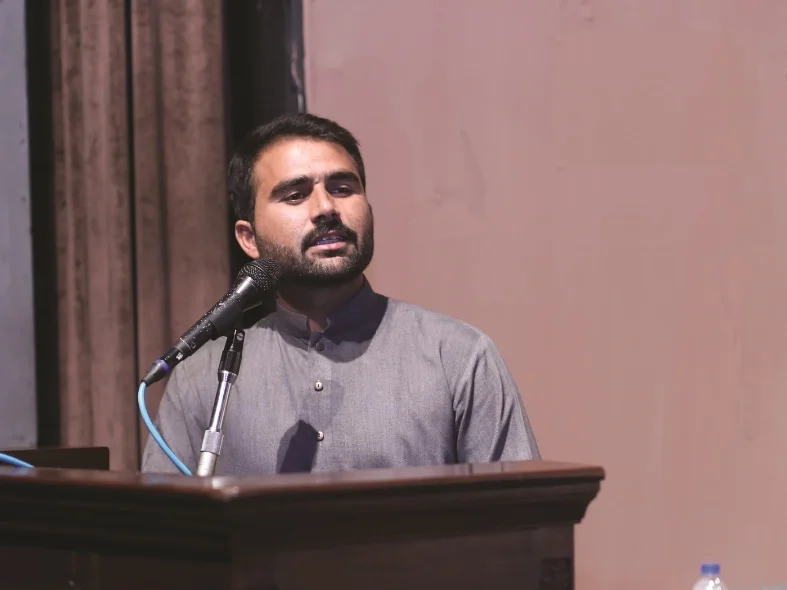
Usman Bilal: from child labourer to CEO
Former child labourer, businessman and child-labour activist. Bunyad–ILO project, Sialkot.
In his own words
I was living in a village in Pasrur, Pakistan, in a family of three brothers, four sisters, my father and mother. With such a large family it was difficult for my father to make a future for us. As a student at the public school I was not encouraged, and was often punished. In 2001, when I was just ten, my parents sent me far away to my maternal uncle’s workshop in the village of Bhagwal Awan, in Sialkot district, to make surgical instruments. I wanted to study more than to work, but I had no choice except to support my family.
I earned Rs 500 a month (about US$8), and I knew this made a real difference to my parents. But the work was hard. Every day I got painful cuts on my hands. My spirit was broken and I felt my future had been snatched away.
After one year, a person from the Bunyad–ILO project came to my uncle’s workshop. He persuaded my uncle to send me, and some of the other young workers, to the Non-Formal Basic Education Centre set up by the project. Every day I worked from 8 a.m. to 3 p.m., then studied at the centre for three hours. The teacher was very kind and the classes were good. When my first primary-level exam came, I came top of my class and was declared the most outstanding student of my session.
Because of this, the ILO persuaded my parents to let me return to formal schooling. Alongside my education I began working as a social activist with the ILO and Bunyad. I never missed a meeting on child labour and children’s rights.
In 2004 I was invited as a child delegate to the first World Congress on Child Labour in Florence, Italy, and took part in the Global March against Child Labour. The next year I went to the second Congress, in New Delhi. I received a Student of the Year Award from the Education Minister of Pakistan and a Leadership Award from the Prime Minister of Pakistan.
None of these achievements would have been possible without the support of Bunyad–ILO and its work against child labour. It changed my life forever. I completed an MBA in Sialkot, and today I own a registered surgical instrument manufacturing company, Care Way, which also supports children’s education.
When I meet others in my industry, they are amazed that a ten-year-old child labourer has grown up to become the CEO of his own company. I am grateful that I can be a role model for other marginalised children. I know there are many more children like me out there, waiting for help.
Founded in 1994, the Bunyad Foundation (Bunyad Literacy Community Council) is a leading NGO dedicated to breaking the cycle of poverty through education and empowerment. From its Lahore headquarters and regional offices, Bunyad works with public and private partners to provide literacy, education, health, and livelihood services across Pakistan’s most under-served areas. Its holistic mission focuses on raising human development by supporting rural families—especially women and children—with access to learning, life skills, and economic opportunities. Today Bunyad’s network spans 5,066 villages across 14 districts of Punjab , with 5 field offices (besides the Lahore HQ) built on its own land.
Scope and Scale of Programs
- Community Learning Centers: Bunyad has established 5,526 non-formal education (NFE) centers in 1,800 villages across 22 districts. These community schools provide basic literacy and numeracy to out‑of‑school children and adults.
- Schools and Classrooms: The Foundation directly runs 6 community-based “Bunyad-e-Fatima” schools , serving 1,167 disadvantaged students, and supports 835 government schools in remote areas, improving enrollment and performance for 78,980 children.
- Offices and Projects: In total, Bunyad has implemented 193 projects to date. Its field presence includes built offices in each major district, reaching over 5,066 villages .
- Beneficiaries: Across all programs, Bunyad has impacted 353,999 direct beneficiaries (77% of them women and girls). Since inception, over 2.6 million men, women, and children have been educated or trained by Bunyad’s initiatives. For example, 417,756 vulnerable children have been brought into schools (with 79% of them achieving basic literacy), and 212,698 rural women have gained new skills or income through 19 dedicated women’s projects across 18 districts.
Education and Learning Initiatives
Education lies at the heart of Bunyad’s work. Its Non-Formal Education (NFE) centers reach children and adults in the most remote villages – providing classes for those excluded from the formal system. In parallel, its community schools and literacy programs have given thousands of adults and out-of-school youth a second chance at learning. Through partnerships with UNESCO and the government, Bunyad’s literacy network has taught over 2.6 million participants (mostly women and children), aligning with global Education-for-All goals.
Beyond classrooms, Bunyad also pioneers vocational and life-skills training . For example, the Khurshid‑Zaman Vocational Training School offers sewing, computer and beautician courses (see image above) to equip girls with sustainable livelihoods. By integrating technical skills with literacy and health education, Bunyad helps youth and adults compete for jobs or start small businesses, lifting whole families out of poverty.
Protecting Children and Ending Child Labor
Bunyad has made child protection a cornerstone of its mission. It runs specialized projects to rescue children from labor and reintegrate them into school. To date, Bunyad has launched 20 child-labor eradication projects that provide formal or informal education to exploited kids. Between 1995 and 2013, it established 10,815 informal learning centers as safe classrooms where children also receive meals, books and psychosocial support. Through these efforts 417,756 child laborers have been enrolled in education – a testament to breaking the cycle of exploitation.
In crises, Bunyad acts swiftly. During the 2022 floods in Rajanpur, it set up 18 temporary learning centers (TLCs) for displaced families. These TLCs served 928 children directly (10,530 total beneficiaries) by offering trauma-informed education and recreational activities. For its flood relief work, UNICEF honored Bunyad with a Best Coordination Award for outstanding response in Muzaffargarh (2011).
Empowering Women and Families
Women’s empowerment is a core impact area. Bunyad designs programs that educate and skill women to become breadwinners and leaders in their communities. For example, women are taught tailoring, embroidery, and basic IT, alongside health and rights education. As a result, 212,698 rural women have increased their economic prospects through Bunyad’s training projects. This focus on female empowerment means that about 77% of Bunyad’s beneficiaries are women and girls.
These women-centered programs build confidence and independence: literacy classes are paired with small-loan schemes or goats-for-farmers projects so that families can earn income immediately. Mothers learn about nutrition, vaccination, and hygiene (often via mobile health camps), which uplifts whole households. In effect, educating one woman in a village has multiplied benefits across her family and community – a ripple of progress that Bunyad tracks year after year.
Health, Well-being and Resilience
Beyond education, Bunyad addresses health and basic needs. It organizes health camps (e.g. collaboration with Rescue 1122 first responders) and public-awareness drives on nutrition and sanitation in rural districts. Notably, under the “Hepatitis-Free Pakistan” initiative, Bunyad and partner organizations ran 46 screening camps for hepatitis B and C in cities and villages like Lahore, Sialkot, Rajanpur, Rahim Yar Khan and others. These campaigns have detected illnesses early and connected people to treatment, protecting families from chronic disease.
Bunyad also builds community resilience to disasters. In flood, earthquake or emergency situations, its teams provide schooling, counseling and relief to affected children and families (as described above). Through sustainable interventions – such as training on climate-smart agriculture and setting up chicken and goat-raising programs – the foundation helps communities recover quickly and prepare for future shocks.
Key Achievements and Awards
Bunyad’s results have earned national and international recognition. Its founder, Shaheen Attiq‑ur‑Rehman, received Pakistan’s Presidential “Aizaz‑e‑Fazilat” Award (1996) for literacy promotion. UNESCO honored the organization with the Comenius Medal (1998) and King Sejong Prize (2002) for innovation in literacy work. UNICEF has repeatedly acknowledged Bunyad’s impact – granting Best Coordination awards for its literacy campaigns and disaster relief. At the national level, Bunyad won Agaahi Awards for outstanding community work (2015) and various literacy awards for excellence in adult education.
Together, these honors reflect milestones in Bunyad’s 30‑year journey. Milestones include reaching 2.6 million learners in total, launching 193 projects across multiple sectors, and building sustainable institutions (like 6 schools and 5 regional offices) to continue the mission. Through every success, Bunyad emphasizes data and accountability – tracking outcomes (such as literacy rates, school enrollment, income increases) to continually improve its programs.
A Brighter Future for Millions
Today, Bunyad Foundation stands as a beacon of hope for Pakistan’s most marginalized communities. Its integrated approach – combining education, child protection, women’s empowerment, health services, and disaster relief – amplifies impact across generations. With a continued focus on the Sustainable Development Goals, Bunyad is on track to expand province-wide and bring literacy and opportunity to millions more.
By strengthening families from the ground up, Bunyad not only changes individual lives but transforms villages. Every statistic – from the thousands of learning centers to the millions of men, women and children reached – tells a story of lives uplifted. As one student’s success becomes a catalyst for an entire neighborhood, Bunyad’s story is ultimately one of resilience, dignity and human potential . The foundation’s ongoing legacy is to ensure that every child can dream, learn and thrive, and every woman can lead her family toward a better future.
Case study · Aawaz II, Sialkot
A Christian family’s fight for their daughter’s birth registration
Introduction: Birth registration is not just a legal necessity—it’s a fundamental human right. This case recounts the powerful journey of a family, a Christian household living in a predominantly Muslim community in District Sialkot, who faced religious discrimination while attempting to register their newborn daughter born on November 25, 1995. Their determination to claim their child’s rightful identity led to a ripple effect of justice and community transformation.
Presenting Challenges
- Religious Discrimination: Union Council staff delayed registration citing biased and discriminatory views towards the family’s Christian faith.
- Pressure to Convert: The family was shockingly advised to convert to Islam as a means to ease the process—a suggestion they courageously rejected.
- Unjust Paperwork: Despite having all required documents, they were asked to produce additional, unnecessary paperwork not mandated by law.
- Community Pressure: Being a minority in a conservative community, they endured social pressure to comply quietly and surrender their identity.
Intervention and Support
- Legal Backing: Human rights lawyers intervened, outlining legal provisions and helping the family build a strong case against the injustice.
- Media Exposure: The family’s story was publicized in local and national media, drawing widespread attention and public sympathy.
- Advocacy by Bunyad: With support from the Aawaz II Program , Bunyad Literacy and Community Council organized community education drives promoting religious harmony and equal rights.
- Government Dialogue: Civil society groups engaged with government officials to reform registration policies and investigate the incident.
Outcome
- Official Registration: The birth was successfully registered after community, legal, and media pressure.
- Union Council Apology: An official apology was issued and staff involved faced disciplinary action.
- Policy Reform: The birth registration process was streamlined and unnecessary barriers removed to ensure fairness for all religions.
- Ongoing Awareness: Interfaith campaigns and education programs continue to build a culture of inclusion and tolerance.
Conclusion
The family’s courage and unwavering commitment to justice underscore the power of grassroots advocacy and solidarity in combating systemic discrimination. Their journey demonstrates that even in the face of adversity, positive transformation is achievable. This case study stands as a testament to Bunyad’s mission to empower communities and defend fundamental rights, ensuring dignity, justice, and inclusion for every citizen regardless of faith.
UNESCO · ILO · UNICEF · USAID
Recognition from our partners
UNESCO Recognition
UNESCO has honored Bunyad Foundation for its innovative literacy programs:
- Comenius Medal (1998) and King Sejong Literacy Prize (2002): Awarded for exceptional contributions to literacy and non-formal education.
- Mobile-Based Post Literacy Programme: Implemented in collaboration with UNESCO, this initiative empowered learners, especially women, to read Urdu newspapers, understand the Holy Quran through translations, and utilize mobile phones for educational purposes. Participants expressed profound gratitude: UNESCO Institute for Lifelong Learning “I would like to say thanks to UNESCO and BUNYAD for enabling us. Before joining this programme I did not know how to read and write but now I have come to know how to read and write.” UNESCO Institute for Lifelong Learning
ILO & UNICEF Collaboration
In a joint effort with ILO and UNICEF, Bunyad Foundation played a pivotal role in eliminating child labor in Pakistan’s football manufacturing industry:
- Sialkot Partners’ Agreement (1997): This initiative aimed to prevent and eliminate child labor under the age of 14 in the football manufacturing sector. Bunyad was instrumental in providing educational opportunities and support services to affected children and their families.
USAID Support
USAID, through the Pakistan Initiative for Mothers and Newborns (Paiman) Project, awarded grants to Bunyad Foundation to enhance health services in rural communities:
- Maternal and Newborn Health Projects: These grants aimed to improve emergency transportation and health services for mothers and newborns in rural areas, benefiting over 130,000 individuals.